Rahiba R. Parveen
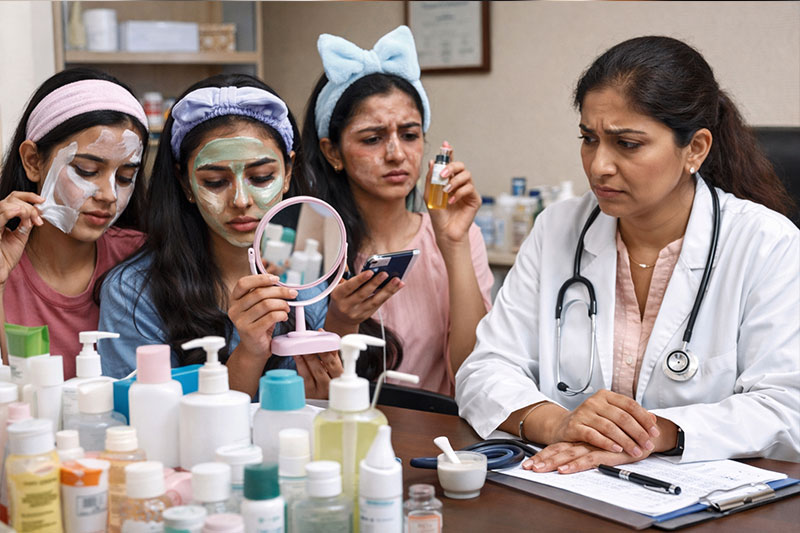
Kiara Gupta (17) developed a severe acne breakout soon after finishing her board exams. Eager to start a new academic phase and influenced by her peers, she turned to a Korean skincare routine that promised “glass skin” and quick acne control. What followed was far from the glowing results she expected.
“Within days, I woke up with scaly, burning skin. My face had turned red and was covered in rashes. It was a nightmare,” said Kiara. Acting on recommendations from skincare influencers on Instagram, she had started using a salicylic acid serum—widely marketed as a solution for acne. Unaware that her skin type was dry, Kiara ended up damaging her skin barrier, triggering inflammation and irritation instead of healing.
Dermatologists say Kiara’s experience is becoming increasingly common among teenagers who experiment with potent skincare products without medical guidance.
Dr. Nitin S. Walia, Senior Consultant in Dermatology at Max Hospital, Saket, warns that blind faith in social media skincare advice can have serious consequences. “We frequently see young patients—especially girls—who suffer skin barrier damage, allergies, and flare-ups after following influencer-led skincare routines. Using active ingredients without understanding one’s skin type can be harmful,” he said.
According to Dr. Walia, teenagers and young adults rarely need elaborate skincare regimens. “Moisturisers and sunscreen are the most effective anti-ageing products at this age. For persistent acne or allergies, a dermatologist should be consulted instead of blindly following Korean, Japanese, or other trending routines online,” he added.
Medical literature also reflects growing concern. A study published on PubMed Central highlighted how children and adolescents are particularly vulnerable to being influenced by social media-driven skincare trends. Titled ‘Kids These Days: Social Media’s Influence on Adolescent Behaviors’, the research presented two case studies illustrating the risks.
In one instance, a teenager developed allergic contact dermatitis after using “snail slime,” a popular over-the-counter product promoted for hydration on social media. Another adolescent was rushed to a clinic after her mother noticed sudden “overnight moles,” which turned out to be marks created using a viral, influencer-endorsed “freckle stamp.” The study emphasised that clinicians must remain alert to such trends to better educate and protect impressionable teenage patients.
Doctors further caution against the rising use of aggressive ingredients such as glutathione, retinoids, and strong exfoliating acids among youngsters. “These products can cause contact dermatitis, pigmentation, acne flare-ups, sensitivity, and rebound pigmentation,” experts said, adding that oral or nasal use of glutathione—often promoted online—can even pose risks to liver health.
Dr. Rishi Parashar, Chairman of Dermatology at Sir Gangaram Hospital, New Delhi, expressed alarm over the popularisation of elaborate “10-step AM-PM” skincare routines for young people. “If someone claims a 20-year-old needs a 10-step routine morning and night, I would call it sheer nonsense,” he said. “This culture of manufacturing self-doubt has existed for decades, but today it has evolved into a social media menace built on artificial beauty standards, which can have serious medical and social consequences.”
Dr. Parashar also criticised skincare influencers for eroding trust between doctors and patients. “When a doctor says a long skincare list isn’t required, patients feel disappointed. But a digital influencer creates detailed routines that followers consume unquestioningly, almost like faith. This has led to rising insecurities—the fair want to be fairer, the young want to look younger. A 14-year-old is still growing, so why would they need anti-ageing products?” he asked, adding that this has made the doctor-patient relationship increasingly strained.
He also pointed out the lack of scientific evidence supporting many trending skincare practices, including rice water, collagen drinks, and ginseng supplements frequently promoted online.
While countries like Australia have taken steps to restrict social media use for children under 16 to curb digital harm, India continues to lack strong regulations governing online beauty content. Addressing the issue, celebrity nutritionist Rujuta Diwekar recently shared a video urging restraint in skincare consumption among young people.
“The only real blemish is insecurity and the constant need for external validation,” she said. “A pimple, acne mark, or bump is part of growing up. These issues settle when children eat well, sleep on time, and stay active.”
Calling on parents to intervene, Diwekar added, “It breaks my heart to see 11-, 12-, 13-, and 14-year-olds buying anti-ageing masks, under-eye patches, and countless lip products. Parents must learn to say no—even if it leads to short-term conflict—because unchecked skincare obsession only deepens insecurity.”