Minal Sancheti
At the age of 27, childbirth marked the beginning of emotional darkness rather than joy for Mayuri S.
“It was a planned pregnancy and I was mentally prepared but the moment my son was born, it felt like a curtain dropped on me. There was a heavy, gloomy feeling—no happiness, no connection, no excitement,” said Mayur who was an international student at that time.
For most people, motherhood is a romanticised idea where one thinks that a mother’s pain goes away simply by looking at the child’s face. The problem with this, is that it ignores the silent psychological toll that childbirth can take on many women.
While postpartum depression (PPD) has slowly begun to enter public conversation, an even more neglected condition is postpartum post-traumatic stress disorder (PTSD). Many women suffer from it, but it still continues to remain largely invisible, misunderstood, and undiagnosed.
Postpartum mental health disorders exist on a spectrum, ranging from baby blues to depression, anxiety, psychosis, and PTSD. Yet most healthcare conversations stop at physical recovery, leaving mothers unprepared for the emotional aftermath of pregnancy and childbirth. For many women, birth is not merely exhausting—it is traumatic.
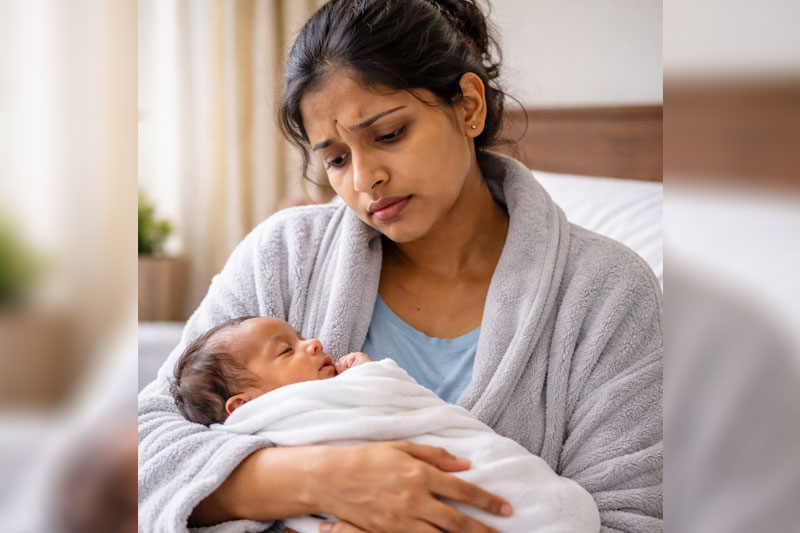
Mayuri, quoted above in the story, describes her feelings for her newborn, as though caring for him was just another chore. “When I came home after 21 days, I didn’t want to be with my baby at all. I wanted my parents or in-laws to take over. I couldn’t even be alone with him for five minutes,” she recalls. She experienced uncontrollable crying spells, emotional shutdowns, sudden anger, and an aversion to breastfeeding—classic symptoms seen in postpartum PTSD and depression.
Her recovery only began after a local physician recognised her distress and intervened. Later, she consciously worked on rebuilding her bond with her son by spending extended time alone with him. Her experience highlights how trauma, if left unaddressed, can fracture the mother–child relationship in the earliest, most formative stage.
Postpartum PTSD can develop after a traumatic childbirth experience—such as prolonged labour, emergency C-sections, severe pain, medical complications, loss of control, or lack of emotional support. Unlike depression, PTSD is rooted in trauma and fear, often marked by flashbacks, nightmares, emotional numbness, hypervigilance, guilt, and avoidance—sometimes even of the baby itself.
Journalist Diana Sahu experienced an emotional collapse after delivering a premature baby. “The depression began almost immediately. I was terrified of losing work while struggling to care for my child,” she says. “I had breakdowns but no safe space to talk about them. Maternal healthcare here rarely considers the mental wellbeing of the caregiver.”
Mumbai-based media professional Ria Jain also struggled due to delayed support. “Therapists would give appointments months later. Doctors prescribed habit-forming antidepressants without addressing sleep deprivation and cortisol spikes,” she says. Her experience underscores the systemic gaps in mental healthcare access for new mothers—especially in urban settings.
The effects of postpartum PTSD extend beyond the mother. “A woman with untreated postpartum mental illness may neglect feeding, fail to interpret the baby’s cues, feel trapped or frustrated when the baby cries, and rely excessively on others for caregiving,” says Gemavat. “She may be afraid to be alone with her child.” Such emotional withdrawal can impact early attachment and long-term child development.
Dr Kersi Chavda, psychiatrist, notes that postpartum mental health disorders are among the most under-recognised conditions globally. “PPD affects one in five women worldwide, with Indian studies suggesting similar or higher rates, particularly among women facing financial stress or limited family support,” he says.
PTSD following childbirth often goes undiagnosed because its symptoms are mistaken for exhaustion or anxiety.
The first three months after delivery are especially critical. Honey Gemavat, MS DNB MRCOG, Obstetrician and Gynaecologist, explains that during this period, up to 15–20% of women experience mental health challenges due to sleep deprivation, sudden hormonal shifts, previous mental health history, poor marital relationships, or lack of social support. When trauma is layered onto these vulnerabilities, PTSD can emerge.
Yet early awareness and coping strategies can make a crucial difference. Yoga teacher and creative producer Divya Rao credits her mindfulness practices with preventing severe postpartum distress. “I was never warned about how hard it would be—the sleepless nights, hormonal chaos, brain fog,” she says. “Meditation and yoga helped ground me. Even if I had just one hour, I used breathing practices to calm my nervous system.”
In rural and marginalised communities, support often comes from grassroots workers. ASHA workers play a critical role in educating women about postpartum changes. Surekha Khairnar, who works with tribal women in Nagpur, helped Sarla Sonawane navigate childbirth with confidence. “She explained what I might feel after delivery and was there even at 2 am when I needed medical help,” Sonawane recalls. Such consistent support can prevent trauma from escalating into PTSD.
Experts stress that postpartum PTSD and depression are treatable—but only if detected early. Screening during pregnancy, especially for women with a history of trauma or mental illness, is essential. “Doctors must differentiate between baby blues, which resolve within two weeks, and more serious conditions,” says Gemavat. Chavda adds, “These conditions rarely improve without intervention. Safety of both mother and infant must be prioritised, along with medical evaluations to rule out thyroid or obstetric complications.”
Awareness is the first step toward prevention. Postpartum PTSD has always existed—women have simply suffered in silence. Honest conversations before childbirth, proactive screening, family support, and timely medical care can ensure that motherhood does not begin with trauma, but with healing.